How to Read a Skincare Label: Decode Ingredients Like a Dermatologist

You’re standing in a pharmacy in Rawalpindi, holding two “brightening” creams. One costs Rs. 400, the other Rs. 1,800. The front labels both promise glowing skin. So how do you actually know which one is safe?
The answer is on the back. Learning how to read a skincare label: decode ingredients like a dermatologist is the single most useful skincare skill you can build — more useful than any influencer recommendation. Once you know what you’re looking at, you stop guessing and start choosing products that genuinely work for your skin.
This guide breaks it down in plain language, so you never feel lost in front of an ingredient list again.
Why Reading Skincare Labels Matters
Quick answer: Reading a skincare label tells you exactly what’s in a product, in what strength, and whether it suits your skin type — before you spend money or risk a reaction.
Pakistan’s beauty market has grown fast, and with that growth has come a flood of unregulated, mislabeled, and sometimes counterfeit products. A pretty jar and a bold marketing claim don’t guarantee safety. The ingredient list does.
Real experience backs this up: a patient with sensitive skin who reacts to a “gentle” cleanser almost always finds a hidden fragrance or alcohol ingredient buried in the list — not on the front label, but in the fine print at the back.
How Ingredient Lists Work: Understanding INCI Names
Every legitimate cosmetic product lists ingredients using INCI (International Nomenclature of Cosmetic Ingredients) — a standardized naming system used worldwide, including by regulators like the FDA.
- INCI names look scientific (e.g., “Niacinamide” instead of “Vitamin B3”) because they’re standardized for global consistency.
- Ingredients are always listed in descending order of concentration.
- Water (Aqua) is almost always first, since most products are water-based.
Dermatologist Tip: If you don’t recognize an ingredient, search its INCI name specifically — not the brand’s marketing term for it.
Active vs. Inactive Ingredients
Active ingredients are the ones doing the actual work — treating acne, fading pigmentation, hydrating, or protecting from UV rays. Common actives include:
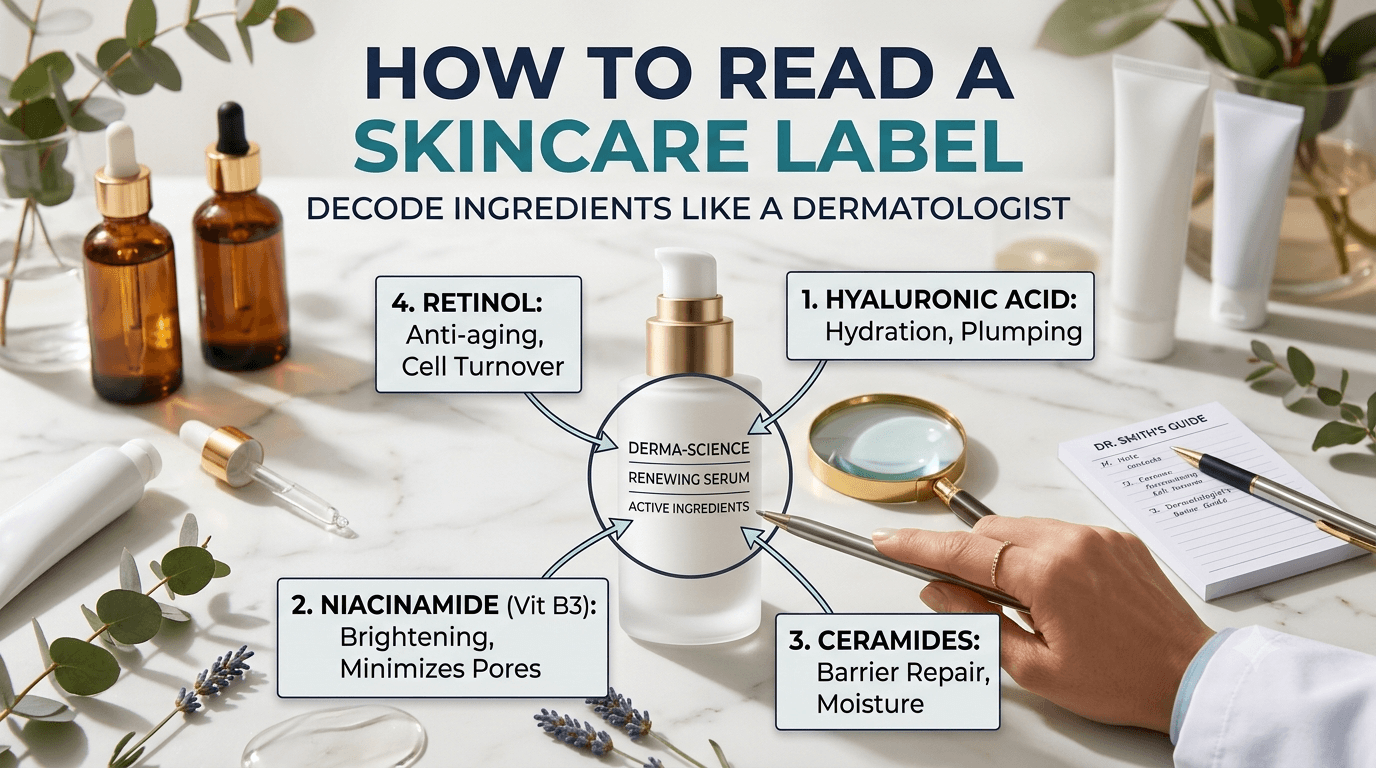
- Retinol (anti-aging, cell turnover)
- Niacinamide (oil control, brightening)
- Salicylic Acid (acne, pore-clearing)
- Glycolic Acid (exfoliation, texture)
- Hyaluronic Acid (hydration)
- Vitamin C (brightening, antioxidant)
- Zinc Oxide / Titanium Dioxide (sunscreen protection)
Inactive ingredients support the formula — think emulsifiers, thickeners, and preservatives. They’re not filler; they keep the product stable and usable, but they’re not the ones treating your skin concern.
Ingredient Concentration and Order: Why Position on the Label Matters
An ingredient listed near the top of the list makes up a much larger percentage of the formula than one listed near the bottom. This is why a serum showing “Niacinamide” in position two is far more potent than a face wash showing it in position fifteen.
Common Mistake: Buying a product because it has a trendy ingredient buried at the very end of a long list — at that position, it’s likely present in a negligible, cosmetically insignificant amount.
Preservatives: Not the Enemy
Preservatives (like phenoxyethanol or sodium benzoate) prevent bacteria and mould from growing in your product. Without them, that lovely serum would spoil within weeks — especially in Pakistan’s heat and humidity.
Dermatologist Tip: Fear of “chemical-sounding” preservative names is usually misplaced. What matters more is checking for parabens and sulfates, which some people prefer to avoid due to sensitivity or personal preference — look for “paraben-free” and “sulfate-free” labeling if that matters to you.
Fragrance Ingredients and Allergens
“Fragrance” or “Parfum” on a label can represent a mix of dozens of undisclosed compounds — a common trigger for sensitive skin and contact dermatitis.
- If you have reactive or sensitive skin, prioritize fragrance-free skincare.
- Common allergens to watch for: essential oils, alcohol denat., and certain dyes.
- Always patch test a new product on your inner arm for 24–48 hours before applying it to your face.
Expiration Dates and the PAO Symbol
Look for two things on packaging:
- Expiration date — a fixed date the product is safe until.
- PAO symbol — a small jar icon with “12M” or “6M,” meaning “Period After Opening.” It tells you how many months the product stays safe once opened, regardless of the printed expiry date.
Quick definition: PAO = the safe-use window that starts the day you open the product, not the day you bought it.
Certifications Worth Trusting
Genuine certifications add a real layer of trust:
- Dermatologically tested
- Cruelty-free
- Lab tested
- Non-comedogenic (won’t clog pores)
Be cautious of vague seals with no verifiable source — a certification logo means little without a claim you can actually check.
Fake Marketing Claims to Watch For
Google AI Overview and quick-answer summary: words like “100% natural,” “miracle cure,” or “instant results” are marketing language, not clinical claims — always verify against the actual ingredient list.
Red flags include:
- “Clinically proven” with no study cited
- “Chemical-free” (everything, including water, is a chemical)
- Before/after photos with no ingredient transparency
Ingredients to Avoid — By Skin Type
| Skin Type | Look For | Avoid If Prone To Irritation |
|---|---|---|
| Oily Skin | Niacinamide, Salicylic Acid | Heavy oils, thick occlusive butters |
| Dry Skin | Hyaluronic Acid, Ceramides, Shea Butter | High-strength alcohol, harsh sulfates |
| Sensitive Skin | Aloe Vera, Panthenol, Green Tea Extract | Fragrance, essential oils, alcohol denat. |
| Acne-Prone Skin | Salicylic Acid, Zinc, Niacinamide | Comedogenic oils, heavy silicones |
| Combination Skin | Niacinamide, lightweight Hyaluronic Acid | Overly rich creams on the T-zone |
Ingredient Purpose Table
| Ingredient | Purpose | Best For | Avoid If |
|---|---|---|---|
| Niacinamide | Oil control, brightening, barrier repair | Oily, acne-prone, combination skin | Rarely an issue; generally well tolerated |
| Retinol | Anti-aging, cell turnover | Mature or textured skin | Pregnancy, very sensitive/reactive skin |
| Salicylic Acid | Unclogs pores, reduces acne | Acne-prone, oily skin | Very dry or compromised skin barrier |
| Glycolic Acid | Exfoliation, texture, tone | Dull, uneven skin | Sensitive skin without gradual introduction |
| Hyaluronic Acid | Deep hydration | Dry, dehydrated, all skin types | No major restrictions |
| Vitamin C | Brightens, fades hyperpigmentation | Dull skin, melasma, dark spots | Very sensitive skin (start low strength) |
| Ceramides | Rebuilds skin barrier | Dry, sensitive, compromised skin | No major restrictions |
Want products already built around these actives instead of guessing? Hi-Lift’s serums range is formulated with clearly labeled concentrations, including Niacinamide 10% + Zinc 1% for oil control and Salicylic Acid 2% for acne-prone skin — so you can match the ingredient to your skin type without decoding a foreign label first.
Common Mistakes Pakistani Buyers Make
- Trusting the front label over the ingredient list
- Ignoring PAO symbols and using expired products past safety
- Assuming “herbal” or “natural” automatically means safe for sensitive skin
- Skipping the patch test before trying a new active ingredient
- Buying from unverified sellers with no batch or manufacturing details
Buying Checklist: What to Check Before You Buy
- Ingredient list is visible and printed clearly (not vague or missing)
- Active ingredient and its percentage are stated where relevant
- No hidden fragrance if you have sensitive skin
- PAO symbol and expiration date are present
- Product matches your specific skin type and concern
- Brand has verifiable manufacturing and contact details
If a product fails more than one of these checks, it’s worth reconsidering — no matter how attractive the packaging looks.
Building This Into Your Routine
Once you know how to read a skincare label, applying it daily gets easier. Start with your cleanser — Hi-Lift’s face wash range lists gentle, skin-friendly ingredients clearly, which makes it a good first swap if you’re currently unsure what’s in your current cleanser.
If your main concern is dullness or uneven tone, check the label of your current brightening product against one built with transparent actives, like the Alpha Arbutin 2% + Hyaluronic Acid serum — a combination dermatologists commonly recommend for hyperpigmentation and hydration together.
And if dry patches or a compromised barrier are your concern, the Hyaluronic 2% + Vitamin B3 serum pairs hydration with barrier-supporting niacinamide — exactly the kind of ingredient pairing this guide has walked you through.
For textured or congested skin, Hi-Lift’s AHA 30% + BHA 2% exfoliating serum is worth comparing label-to-label against whatever exfoliant you’re currently using — you’ll likely notice a clearer concentration breakdown. If you’re deciding between chemical and physical exfoliation methods altogether, our detailed comparison on chemical exfoliants vs. physical scrubs is a useful next read.
Men navigating skincare for the first time often find ingredient lists especially confusing — our step-by-step skincare routine guide for men in Pakistan breaks down which actives matter most, in the same plain-language style as this guide.
For a broader library of dermatologist-inspired advice, browse the rest of our Beauty Tips blog, or explore our full facial kits range if you’re building a complete routine rather than a single product.
Conclusion
Knowing how to read a skincare label: decode ingredients like a dermatologist puts the power back in your hands. You no longer need to trust a pretty box or a bold claim — you can look at the actual ingredient list, understand the concentration, check the PAO symbol, and know within seconds whether a product suits your skin.
Make this your habit for every future purchase: flip the product over before you flip for the packaging. Pakistani skincare buyers deserve safe skincare, not guesswork.
Ready to shop with confidence? Browse Hi-Lift Skincare’s full product range — every formula is built around ingredients you can actually read and understand, not hidden behind vague marketing.
FAQs
Q1: What is the most important part of a skincare label? The ingredient list, since it’s listed in order of concentration and shows exactly what you’re putting on your skin.
Q2: What does INCI mean on a skincare label? INCI stands for International Nomenclature of Cosmetic Ingredients, the standardized naming system used on labels worldwide.
Q3: How can I tell if a skincare product is expired? Check both the printed expiration date and the PAO symbol, which shows how many months it’s safe to use after opening.
Q4: Are fragrance-free products better for sensitive skin? Yes, fragrance-free products generally reduce the risk of irritation and allergic reactions for sensitive skin types.
Q5: Does ingredient order on a label really matter? Yes, ingredients are listed from highest to lowest concentration, so the first few entries make up most of the formula.